.svg)
FROM "CODE RED" TO GEMINI: How Google Rewired Its Future

Sash Mohapatra

Sash spent 20 years at Microsoft guiding enterprise clients through the cloud revolution and the rise of AI. Now, as the founder of The Rift, he’s on a mission to enhance human potential by helping people develop practical, future-ready AI skills. He writes from a place of deep curiosity, exploring what it means to stay human as machines reshape the world around us.
December 11, 2025

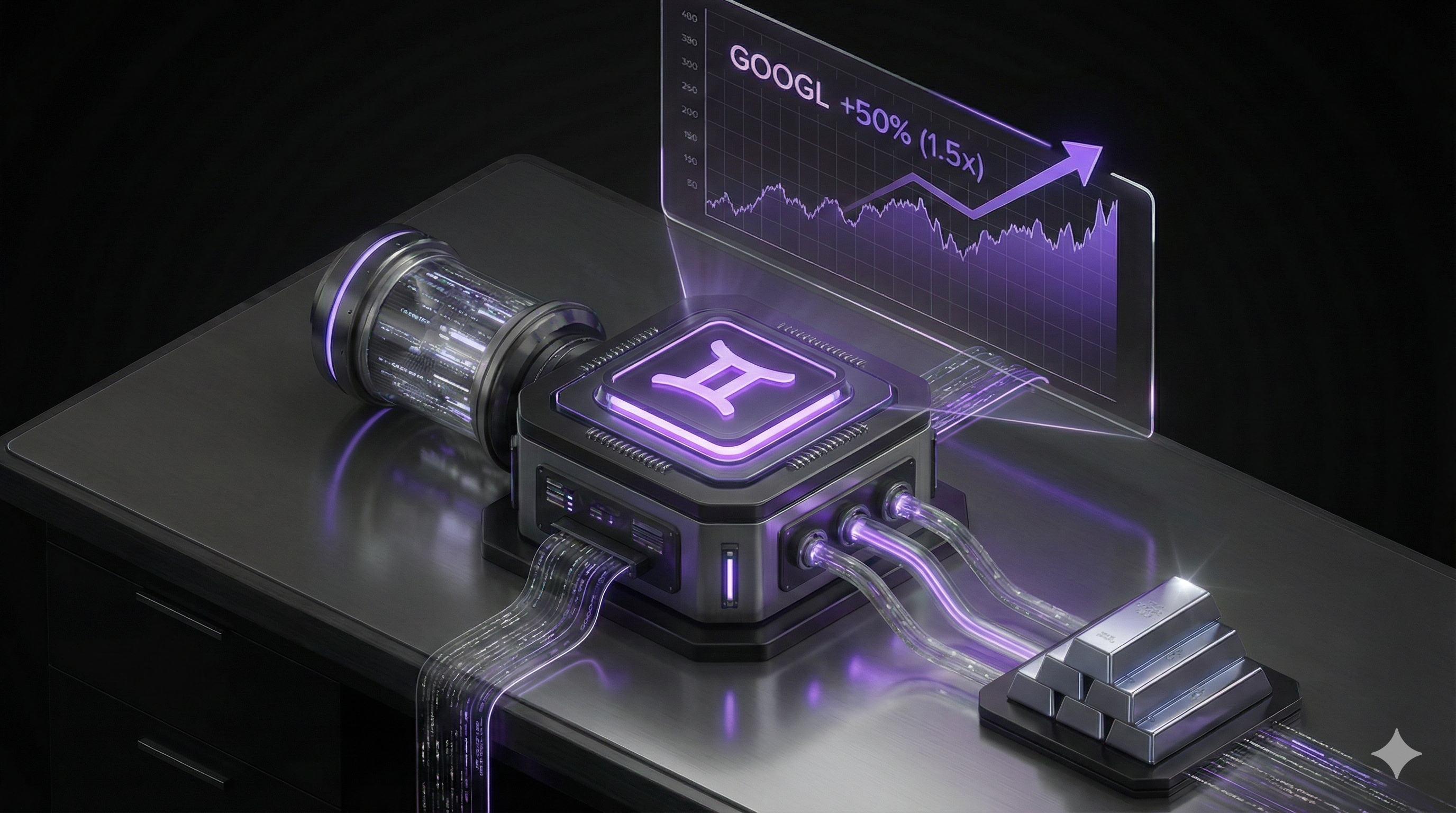
Google's AI comeback story reads less like a clean product pivot and more like a slow‑motion panic attack inside one of the world’s most powerful technology companies. For the first time since the early mobile era, the Google machine looked genuinely rattled, even with DeepMind in the building and decades of frontier research already on its balance sheet.
The moment the moat cracked
From the outside, Google looked unshakeable: a search monopoly, an ad engine printing tens of billions in profit, and a research arm that had already produced AlphaGo and AlphaFold. The company’s economic engine rested on one simple, durable behavior: people typed a query into a box, scanned a page of blue links, and clicked out to the web, generating ad impressions along the way.
Then late 2022 happened. ChatGPT escaped the lab, picked up more than a million users in days, and suddenly the default sentence in tech circles was: “I just asked the AI instead of Googling it.” Detailed reporting describes senior Google executives actually using the phrase “code red” to describe what this meant for Search, putting ChatGPT in the same threat category as the browser and the iPhone. The moat around Search didn’t vanish overnight, but it stopped looking like a moat and started looking uncomfortably like technical debt.
Subscribe now to unlock the full article and gain unlimited access to all premium content.
SubscribeGAI comeback story reads less like a clean product pivot and more like a slow‑motion panic attack inside one of the world’s most powerful technology companies. For the first time since the early mobile era, the Google machine looked genuinely rattled, even with DeepMind in the building and decades of frontier research already on its balance sheet.
The moment the moat cracked
From the outside, Google looked unshakeable: a search monopoly, an ad engine printing tens of billions in profit, and a research arm that had already produced AlphaGo and AlphaFold. The company’s economic engine rested on one simple, durable behavior: people typed a query into a box, scanned a page of blue links, and clicked out to the web, generating ad impressions along the way.
Then late 2022 happened. ChatGPT escaped the lab, picked up more than a million users in days, and suddenly the default sentence in tech circles was: “I just asked the AI instead of Googling it.” Detailed reporting describes senior Google executives actually using the phrase “code red” to describe what this meant for Search, putting ChatGPT in the same threat category as the browser and the iPhone. The moat around Search didn’t vanish overnight, but it stopped looking like a moat and started looking uncomfortably like technical debt.
DeepMind in the building, but on the sidelines
The irony was that Google wasn’t short of AI credentials. DeepMind’s AlphaGo beat Lee Sedol in 2016, and follow‑ups like AlphaGo Zero and AlphaZero generalized the approach to other games by 2017, becoming shorthand for “superhuman AI.” AlphaFold then turned that research pedigree into a scientific earthquake: by 2021, DeepMind and partners had predicted the structures of over 200 million proteins, and by 2024, a new version was modeling protein complexes, DNA, RNA, and ligands with enough accuracy that Nature described it as transformational for structural biology.
On paper, this was the most advanced AI shop in the world. Yet when ChatGPT landed, the most visible consumer‑facing conversational agent didn’t come from Google. The crown‑jewel work lived in research, publications, and specialized tools, not in an everyday interface where hundreds of millions of people asked questions. The company had the ingredients, but they were locked in a different part of the building.
Code red as operating mode
The internal “code red” was the moment defensiveness hardened into operating mode. The New York Times and others reported that Sundar Pichai pulled senior leaders back into urgent product reviews and redirected teams toward AI features that could blunt the threat to Search. Business Insider described internal memos and calls where management acknowledged that smaller players faced fewer reputational constraints and could ship faster, while Google’s own safety and bias review processes were now a competitive disadvantage.
This is where you saw the first cracks in Google’s cautious culture. Prototypes that might previously have lived indefinitely in “Labs” were suddenly being pushed out to hundreds of thousands of test users, with warnings about hallucinations and offensive content baked into the pitch instead of being treated as show‑stoppers. The company hadn’t yet found its product, but it had clearly changed its posture.
The messy middle: Bard, Gemini, and an open search field
The Bard era felt like watching a giant aircraft carrier try to turn in a narrow harbor. Bard arrived in early 2023, first on top of LaMDA and then PaLM‑family models, and it landed with the energy of a mandatory response rather than a product with a clear thesis. It could answer questions and write code, but it didn’t feel like it had a reason to exist beyond “we need something that looks like ChatGPT.”
Meanwhile, the market refused to wait. Perplexity and a cohort of AI‑native search interfaces started doing the obvious thing: answer the question directly, show sources in‑line, and collapse the click‑out step that Google depends on. By early 2024, independent trackers were showing Perplexity’s traffic rising from tens of millions of monthly visits in late 2023 to over 140–170 million visits by mid‑2025, with total query volume measured in the hundreds of millions per month and growth rates above 20,000% versus its early days. One 2025 analysis put its share of AI‑search usage in the mid‑single digits—tiny compared to Google, but large enough to send a clear signal: search, as a category, was open again.
At the same time, Google had a confusing family of internal models—LaMDA, PaLM, early “Gemini” work—without a coherent story. The decision to unify everything under the Gemini brand was the quiet turning point. Gemini stopped being just “the next model” and became the umbrella: a name that could sit inside Search, Workspace, Android, and developer tools, and give users a single mental handle for “Google’s AI.”
The suite moment: from feature to platform
Fast‑forward into the Gemini 2.x and 3 era and the story starts to feel less panicked and more strategic. Gemini 1.0 arrived in late 2023 as a multimodal model, but the real platform shift came later as Google turned Gemini into a suite, not a feature. Public documentation and changelogs show a rapid cadence through 2024 and 2025: Gemini models in multiple sizes (Nano for on‑device, Pro and Ultra in the cloud), specialized variants for fast responses and “thinking” tasks, and a unified Gemini API for developers.
Crucially, these models were not left as a standalone chat app. They were wired directly into Google’s existing distribution:
- In Search, Gemini‑powered answer panels began absorbing intent that would previously have spilled out to ten blue links.
- In Workspace, Gemini assistants started drafting emails, summarizing documents, and generating slides inside the tools where knowledge workers already live.
- On Android, Gemini moved closer to the OS, becoming a system‑level assistant rather than a tab in the browser.
This is the moment when Google finally did the very incumbent thing it had been oddly reluctant to do at the start: convert its reach into an AI advantage. Instead of AI eroding the search moat, Gemini began to thicken it again—this time as a reasoning layer running on top of Google’s index and platforms.
The stock market’s verdict
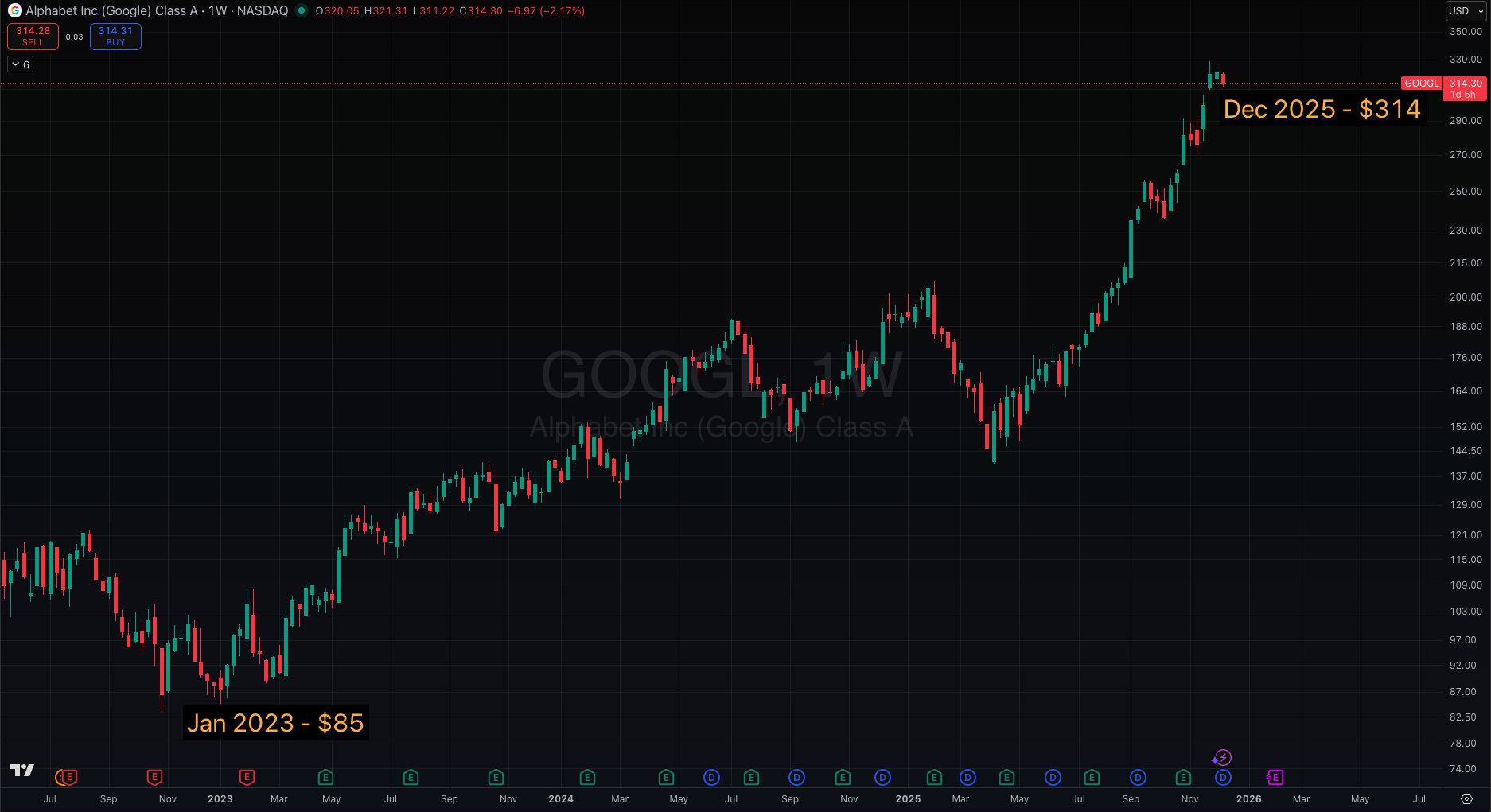
If you zoom out from product to price, the market’s read on this arc is stark. Alphabet’s Class A shares now trade in the low‑ to mid‑300‑dollar range, after spending the last year more than doubling off their lows, with a 52‑week band running roughly from the mid‑140s to the high‑320s. That re‑rating has pushed Alphabet’s market capitalization to around 3.8 trillion dollars, putting it on the cusp of a 4‑trillion‑dollar valuation and firmly in the top tier of global public companies.
On a relative basis, Alphabet has materially outperformed the S&P 500 over the period that maps to this “code red to Gemini suite” narrative, with one 12‑month stretch showing Alphabet returns in the 60–70 percent range versus low‑teens for the index. Reuters and others explicitly tie this latest leg of the rally to “AI‑fueled gains,” citing investor enthusiasm for Gemini’s role in Search and Cloud and the perception that Google has re‑established itself as a core AI platform, not a lagging incumbent.
For a company that, in 2022, was being openly questioned as to whether AI might structurally damage its core business, the fact that it is now flirting with a 4‑trillion‑dollar valuation is a stunning data point. The same existential pressure that produced the code‑red memos is now one of the reasons Alphabet is treated as one of the purest large‑cap AI trades in public markets.
DeepMind’s legacy, repurposed
In the background, DeepMind’s scientific track record continued to matter—not because AlphaFold itself was going to answer your restaurant queries, but because it demonstrated that Alphabet knew how to build and harden very large, high‑stakes models. AlphaFold’s open database of protein structures, created with the European Bioinformatics Institute, now spans almost all known proteins, and by 2025 researchers were crediting it with accelerating work across drug discovery and molecular biology.
That same organizational muscle - training huge models, figuring out how to make them useful outside the lab, and dealing with safety and reliability constraints, feeds directly into a product like Gemini. When you drop Gemini into Search and Workspace, you are effectively taking the culture that built AlphaGo and AlphaFold and pointing it at ad‑driven consumer products for the first time.
The reversal: when the rival hits code red
Three years after Google’s own code red, the narrative began to flip. By late 2025, coverage from business and tech outlets described a mirror image: OpenAI and its CEO Sam Altman sounding their own internal code‑red alarms as Gemini’s adoption and benchmark performance climbed. Reports described OpenAI temporarily freezing or slowing work on side initiatives like ad experiments and some agent features to refocus on core ChatGPT improvements in response to Gemini’s acceleration and Google’s bundling power.
One widely cited piece framed it explicitly: in 2022, Google declared code red over ChatGPT; in 2025, OpenAI declared code red over Gemini. The symbolism matters more than the phrase. It marks the point where the story stops being “incumbent vs upstart” and becomes a genuine two‑way race, with each side forced into uncomfortable, company‑wide shifts.
The emotional arc of an incumbent
Seen from the outside, Google’s emotional arc over these three years is almost textbook:
- Denial: We have better models internally; this is just hype.
- Alarm: The behavioral shift is real; people are bypassing Search.
- Panic: Ship Bard; accept the embarrassment risk.
- Integration: Gemini is the umbrella; plug it into everything.
- Assertion: We’re not just catching up; we’re forcing the other side into its own code red, while the stock market values the company as a multi‑trillion‑dollar AI platform.
What makes this cycle interesting is that Google’s threat was never simply “our models are worse.” The existential risk sat at the level of habit and business model: the possibility that question‑asking would move somewhere Google didn’t control. The comeback, if that’s what we’re watching, is less about one spectacular model drop and more about the slow, political, messy work of rewiring a trillion‑dollar incumbent around an AI‑first posture, under pressure from challengers like OpenAI and Perplexity that proved, very publicly, that the future of search might not look like a search box at all.
GAI comeback story reads less like a clean product pivot and more like a slow‑motion panic attack inside one of the world’s most powerful technology companies. For the first time since the early mobile era, the Google machine looked genuinely rattled, even with DeepMind in the building and decades of frontier research already on its balance sheet.
The moment the moat cracked
From the outside, Google looked unshakeable: a search monopoly, an ad engine printing tens of billions in profit, and a research arm that had already produced AlphaGo and AlphaFold. The company’s economic engine rested on one simple, durable behavior: people typed a query into a box, scanned a page of blue links, and clicked out to the web, generating ad impressions along the way.
Then late 2022 happened. ChatGPT escaped the lab, picked up more than a million users in days, and suddenly the default sentence in tech circles was: “I just asked the AI instead of Googling it.” Detailed reporting describes senior Google executives actually using the phrase “code red” to describe what this meant for Search, putting ChatGPT in the same threat category as the browser and the iPhone. The moat around Search didn’t vanish overnight, but it stopped looking like a moat and started looking uncomfortably like technical debt.
DeepMind in the building, but on the sidelines
The irony was that Google wasn’t short of AI credentials. DeepMind’s AlphaGo beat Lee Sedol in 2016, and follow‑ups like AlphaGo Zero and AlphaZero generalized the approach to other games by 2017, becoming shorthand for “superhuman AI.” AlphaFold then turned that research pedigree into a scientific earthquake: by 2021, DeepMind and partners had predicted the structures of over 200 million proteins, and by 2024, a new version was modeling protein complexes, DNA, RNA, and ligands with enough accuracy that Nature described it as transformational for structural biology.
On paper, this was the most advanced AI shop in the world. Yet when ChatGPT landed, the most visible consumer‑facing conversational agent didn’t come from Google. The crown‑jewel work lived in research, publications, and specialized tools, not in an everyday interface where hundreds of millions of people asked questions. The company had the ingredients, but they were locked in a different part of the building.
Code red as operating mode
The internal “code red” was the moment defensiveness hardened into operating mode. The New York Times and others reported that Sundar Pichai pulled senior leaders back into urgent product reviews and redirected teams toward AI features that could blunt the threat to Search. Business Insider described internal memos and calls where management acknowledged that smaller players faced fewer reputational constraints and could ship faster, while Google’s own safety and bias review processes were now a competitive disadvantage.
This is where you saw the first cracks in Google’s cautious culture. Prototypes that might previously have lived indefinitely in “Labs” were suddenly being pushed out to hundreds of thousands of test users, with warnings about hallucinations and offensive content baked into the pitch instead of being treated as show‑stoppers. The company hadn’t yet found its product, but it had clearly changed its posture.
The messy middle: Bard, Gemini, and an open search field
The Bard era felt like watching a giant aircraft carrier try to turn in a narrow harbor. Bard arrived in early 2023, first on top of LaMDA and then PaLM‑family models, and it landed with the energy of a mandatory response rather than a product with a clear thesis. It could answer questions and write code, but it didn’t feel like it had a reason to exist beyond “we need something that looks like ChatGPT.”
Meanwhile, the market refused to wait. Perplexity and a cohort of AI‑native search interfaces started doing the obvious thing: answer the question directly, show sources in‑line, and collapse the click‑out step that Google depends on. By early 2024, independent trackers were showing Perplexity’s traffic rising from tens of millions of monthly visits in late 2023 to over 140–170 million visits by mid‑2025, with total query volume measured in the hundreds of millions per month and growth rates above 20,000% versus its early days. One 2025 analysis put its share of AI‑search usage in the mid‑single digits—tiny compared to Google, but large enough to send a clear signal: search, as a category, was open again.
At the same time, Google had a confusing family of internal models—LaMDA, PaLM, early “Gemini” work—without a coherent story. The decision to unify everything under the Gemini brand was the quiet turning point. Gemini stopped being just “the next model” and became the umbrella: a name that could sit inside Search, Workspace, Android, and developer tools, and give users a single mental handle for “Google’s AI.”
The suite moment: from feature to platform
Fast‑forward into the Gemini 2.x and 3 era and the story starts to feel less panicked and more strategic. Gemini 1.0 arrived in late 2023 as a multimodal model, but the real platform shift came later as Google turned Gemini into a suite, not a feature. Public documentation and changelogs show a rapid cadence through 2024 and 2025: Gemini models in multiple sizes (Nano for on‑device, Pro and Ultra in the cloud), specialized variants for fast responses and “thinking” tasks, and a unified Gemini API for developers.
Crucially, these models were not left as a standalone chat app. They were wired directly into Google’s existing distribution:
- In Search, Gemini‑powered answer panels began absorbing intent that would previously have spilled out to ten blue links.
- In Workspace, Gemini assistants started drafting emails, summarizing documents, and generating slides inside the tools where knowledge workers already live.
- On Android, Gemini moved closer to the OS, becoming a system‑level assistant rather than a tab in the browser.
This is the moment when Google finally did the very incumbent thing it had been oddly reluctant to do at the start: convert its reach into an AI advantage. Instead of AI eroding the search moat, Gemini began to thicken it again—this time as a reasoning layer running on top of Google’s index and platforms.
The stock market’s verdict
If you zoom out from product to price, the market’s read on this arc is stark. Alphabet’s Class A shares now trade in the low‑ to mid‑300‑dollar range, after spending the last year more than doubling off their lows, with a 52‑week band running roughly from the mid‑140s to the high‑320s. That re‑rating has pushed Alphabet’s market capitalization to around 3.8 trillion dollars, putting it on the cusp of a 4‑trillion‑dollar valuation and firmly in the top tier of global public companies.
On a relative basis, Alphabet has materially outperformed the S&P 500 over the period that maps to this “code red to Gemini suite” narrative, with one 12‑month stretch showing Alphabet returns in the 60–70 percent range versus low‑teens for the index. Reuters and others explicitly tie this latest leg of the rally to “AI‑fueled gains,” citing investor enthusiasm for Gemini’s role in Search and Cloud and the perception that Google has re‑established itself as a core AI platform, not a lagging incumbent.
For a company that, in 2022, was being openly questioned as to whether AI might structurally damage its core business, the fact that it is now flirting with a 4‑trillion‑dollar valuation is a stunning data point. The same existential pressure that produced the code‑red memos is now one of the reasons Alphabet is treated as one of the purest large‑cap AI trades in public markets.
DeepMind’s legacy, repurposed
In the background, DeepMind’s scientific track record continued to matter—not because AlphaFold itself was going to answer your restaurant queries, but because it demonstrated that Alphabet knew how to build and harden very large, high‑stakes models. AlphaFold’s open database of protein structures, created with the European Bioinformatics Institute, now spans almost all known proteins, and by 2025 researchers were crediting it with accelerating work across drug discovery and molecular biology.
That same organizational muscle - training huge models, figuring out how to make them useful outside the lab, and dealing with safety and reliability constraints, feeds directly into a product like Gemini. When you drop Gemini into Search and Workspace, you are effectively taking the culture that built AlphaGo and AlphaFold and pointing it at ad‑driven consumer products for the first time.
The reversal: when the rival hits code red
Three years after Google’s own code red, the narrative began to flip. By late 2025, coverage from business and tech outlets described a mirror image: OpenAI and its CEO Sam Altman sounding their own internal code‑red alarms as Gemini’s adoption and benchmark performance climbed. Reports described OpenAI temporarily freezing or slowing work on side initiatives like ad experiments and some agent features to refocus on core ChatGPT improvements in response to Gemini’s acceleration and Google’s bundling power.
One widely cited piece framed it explicitly: in 2022, Google declared code red over ChatGPT; in 2025, OpenAI declared code red over Gemini. The symbolism matters more than the phrase. It marks the point where the story stops being “incumbent vs upstart” and becomes a genuine two‑way race, with each side forced into uncomfortable, company‑wide shifts.
The emotional arc of an incumbent
Seen from the outside, Google’s emotional arc over these three years is almost textbook:
- Denial: We have better models internally; this is just hype.
- Alarm: The behavioral shift is real; people are bypassing Search.
- Panic: Ship Bard; accept the embarrassment risk.
- Integration: Gemini is the umbrella; plug it into everything.
- Assertion: We’re not just catching up; we’re forcing the other side into its own code red, while the stock market values the company as a multi‑trillion‑dollar AI platform.
What makes this cycle interesting is that Google’s threat was never simply “our models are worse.” The existential risk sat at the level of habit and business model: the possibility that question‑asking would move somewhere Google didn’t control. The comeback, if that’s what we’re watching, is less about one spectacular model drop and more about the slow, political, messy work of rewiring a trillion‑dollar incumbent around an AI‑first posture, under pressure from challengers like OpenAI and Perplexity that proved, very publicly, that the future of search might not look like a search box at all.